Active Learning
What is Active Learning?
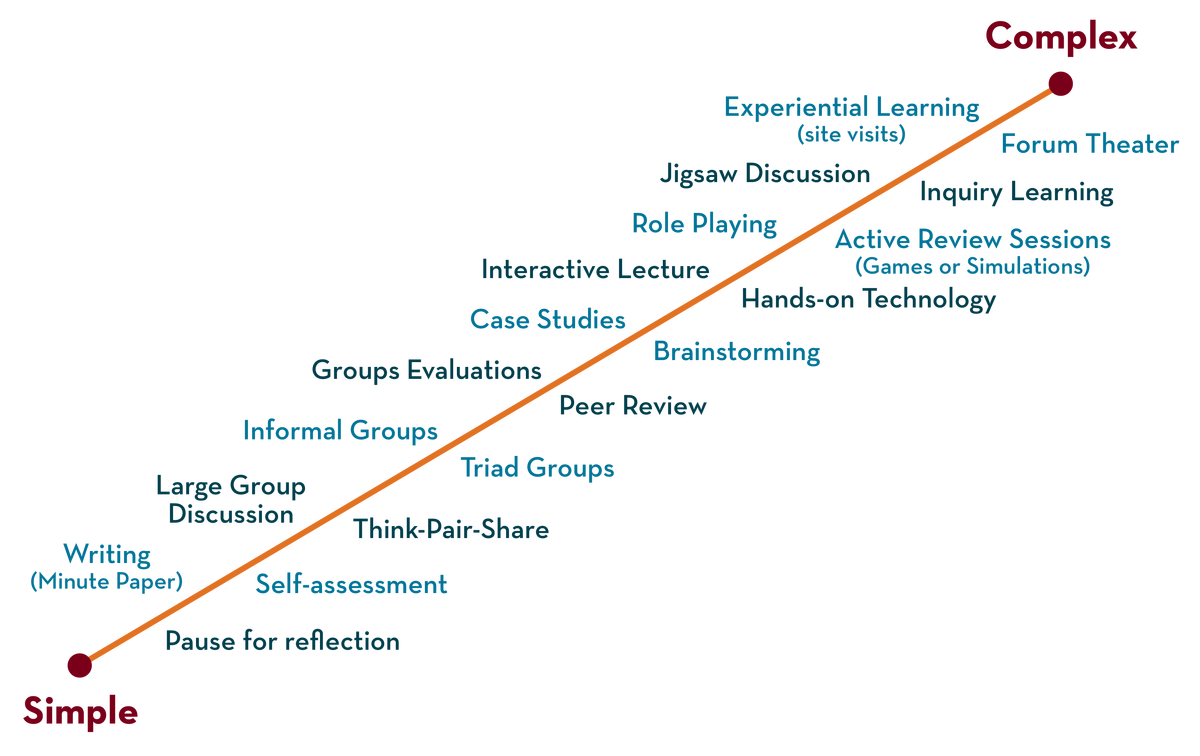
Simply put, active learning is any approach to instruction that allows students to participate in their own learning. Active learning is opposing the 'traditional' style of teaching such as lectures and readings where students are passive recipients of information from their teacher. There are many ways to have students participate in active learning like large group discussion, peer review, and role play. Below I have added a spectrum of active learning activities that allow students to become active participants in receiving knowledge.
 |
| Image Source |
Benefits of Active Learning
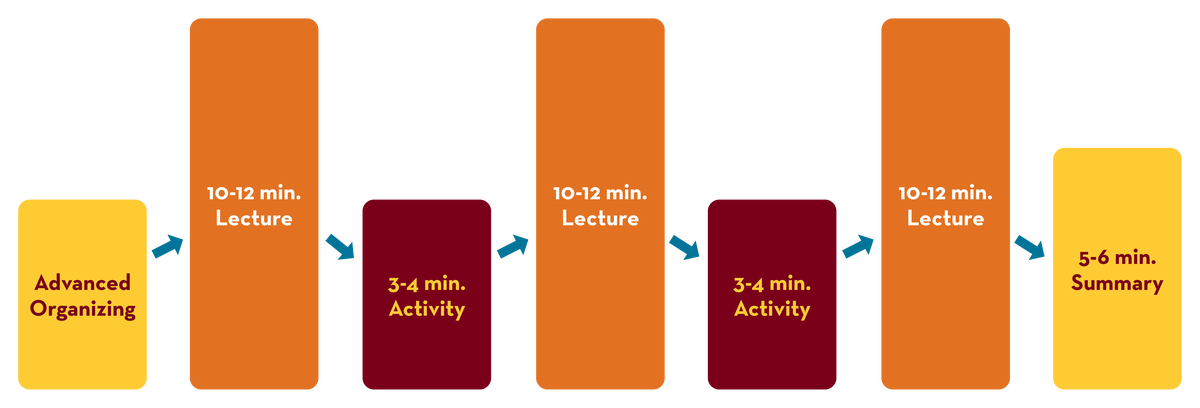
Remember that active learning is students participating in their learning. However, there has to be moments of sharing new content in order to give them something to participate in. This sharing of content/knowledge can come in many different forms like multimodal exposure, guest speakers, and lectures. The trick is to create space within class time to allow students involvement with the new content they are being exposed to. Here is an example of a way students can check their understanding with activities like Think-Pair-Share, small group discussions, or a reflection writing prompt.
 |
| Image Source |
By creating a space for students to participate in the learning process, they are able to gage their level of understanding of new content, use their learning to problem solve, and share made artifacts with peers. On top of the many ways students can share their knowledge, there are a handful of meaningful benefits on how active learning shapes the learning process in the classroom:
- Working on hands-on activities helps students create a personal connection with the material and increases students' motivation to learn
- A strong sense of community is created when students have regular interactions with peers and teachers around shared activities
- Receiving frequent and immediate feedback helps students correct misunderstandings and develop a deeper understanding of course material
- Instructors gain more insight into student processing by interacting with and observing students as they work through activities
- By knowing how students are understanding the content, teachers can target future lessons
Taking a Closer Look
Since we have been looking at all things active learning, I am going to share a really fun example of an elementary class exploring the Revolutionary War. Here, you can check out the activity described with some additional information through the lens of active learning.

The previously mentioned activity shows elementary aged students using multimodal tools to create an artifact of learning. The class used PicCollage to create a visual of a specific topic researched about the Revolutionary War. Additionally, they used Audioboom to record an auditory piece, accessed by QR code, in connection to the visual created. In this activity, students were being clear participants in their learning by collaborating with a group, using hands-on technology, and autonomy of what historical event in the war they wanted to focus on. Students were able to express their learning in a multi-sensory and creative way that allows peers to interact with.
My Experience with Active Learning
For the past seven years of teaching, I have been working at a IB school with constructivist roots. Breaking it down, inquiry-based, transdisciplinary, and active learning were the name of the game when it came to planning and lessons. To make it easier (or harder to some people!), I taught kindergarten which lends itself to more of a hands-on and exploratory way of learning.
One example that comes to mind is when my class was exploring the concept of past and present. One place and time we explored was when the great pyramids were built in ancient Egypt. We mapped this time on a time line counting back hundreds of years in the past, learning about life in ancient Egypt through books and videos, and even went on an interactive, virtual tour of the inside of a pyramid. Once we were familiar with everyday life and uniqueness of life on the Nile, we started to question how the pyramids were built. The teachers read from a great non-fiction series to show students what simple machine was used and how. Finally, the class explored building and using that same simple machine (the inclined plane) in the classroom and surrounding community to solve problems and have fun! Below I have added some pictures of my classroom creating and exploring using the inclined plane.


As you can see from the pictures, the students were able to create this simple machine as a whole group (including the teacher) and in small groups with common materials that are in many early childhood classrooms. Not only was this exciting for the students to feel like they were builders, problem solvers, and creatives through these activities; they brought their learning outside of the classroom and many parents noted how the exploration that started in the class was carrying over into their homes.
Why Active Learning?
As listed in the beginning part of this post, I had mentioned some benefits of active learning for both students and teachers. That was an unbiased, objective list that could relate to classrooms of most ages. Now, I will list some reasons from personal experience that has made the classroom more engaging and lesson planning more meaningful.
- Lesson planning can be open ended, leaving room for students to have autonomy of how they explore a concept
- This could help navigate future lessons and lend itself in knowing your students will be interested and curious
- EX: when students were building their own inclined planes in small groups, they decided how to participate with it once their creation was complete. Some wanted race cars to race down the ramps while others asked for weighted bins to pull up the inclined plane.
- Students do not feel they need to have a right answer in order to participate in the learning process
- With active learning, students will come across a lot of hurdles that become an important part of the process in it of itself - being able to learn from your mistakes, persevere, and ultimately end with the best output of their idea
- EX: during our large group introduction, we read that the inclined plane helped lessen the effort it would take to get a brick from the ground to the place it belongs on the pyramid. We used a spring scale attached to a basket filled with blocks and compared the weight with lifting it directly off the ground and then, again, after each student added their piece to the class-made inclined plane to see if the number on the scale (the effort) went down. **SPOILER ALERT: It did!** But not after the first student, or second, or 10th. It took all students working together and rebuilding the inclined plane over and over to lessen the effort needed. The celebration that happened once they succeeded was so encouraging and infectious.
- Allows all students to participate in new material whether it be a group discussion, group conversation, or creating artifacts of learning
- EX: during both active learning lessons you see above, all students were able to participate and use everyday items to explore a larger concept.
Let me Hear!
I would love to hear some feedback about what active learning you have done in your classroom! How did your students like it? Did it feel scary giving the students that much autonomy over their own work? How did the end result of the project turn out (were the students able to create successful artifacts or was it a hurdle to tweak for coming activities/years)?

Erin, what an insightful post! First of all your images were so effective and informative. I especially loved the spectrum of active learning at the beginning of your post. I also appreciated how much active learning you are already doing in your classroom. I love that it is already part of your schools mission and that you showed how this can apply to any grade level. I think you are right that sometimes the hands on is even easier with the younger students. They are not afraid to play or try, where by the time you get to my sixth graders they are sometimes so afraid to fail they can't even begin. I look forward to learning more ways you engage your students in their learning!
ReplyDeleteRachael, that visual was such a help for me too! Also, I completely agree - the older the students get the more timid they are to make a mistake. I think that is why it was so important for me to go to a school that starts creativity and problem solving from the very beginning. However, it is never too late to start! And slowly becoming comfortable with the trial and error process starting in 6th grade could lead to great success in years to come.
DeleteHi Erin! Wow! What a great informative post. I like that you shared a picture of the spectrum with learning activities. That is an easy way for us to visually see where each falls under. It is great that you work in a school where active learning happens all the time. Thanks for sharing an example of what you did in the classroom. I can totally see how the students felt like builders and even wanted to share it at home. That's when you know that they are truly enjoying their learning!
ReplyDeleteHerlinda, thank you for the encouraging words!
DeleteBravo, Erin. This is an excellent blog post! Thank you for the rich visuals. I loved the simple graphic that shows how we can engage with content in a multimodal way. Your student images from your Egypt/simple machines project were a treat!
ReplyDeleteOh my gosh, I loved reading your post, Erin! Like the comments above me already stated, the visuals you provided were wonderfully informative. The thing that stuck out to me most, however, was when you mentioned the ways that teachers could introduce students to new material. I think that's a place I struggle the most. I want to do all of these wonderful things in my classroom, but I feel like they need to know the basics before we can get to the good stuff. But, I'm all wrong! Introducing new material can be as active as making it a valuable and memorable learning experience and environment for the students.
ReplyDelete